
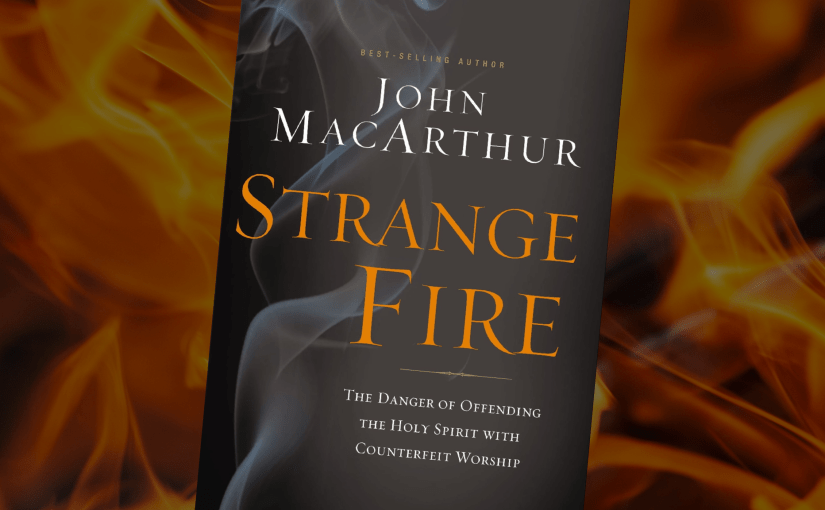
John MacArthur believes that the entire Charismatic Movement is wrong. In his controversial book Strange Fire, he calls on faithful Christians all around the world to rise up, condemn the falsehoods that infiltrated mainstream evangelicalism, and go on a collective war against the pervasive abuses on the Spirit of God perpetrated by Charismatics. With colorful language that borders on sensationalism and an abundance of absolute claims that lack nuance, MacArthur asserts that more than half a billion Christians all over the world espouse heretical doctrines (xiv-xvi).
This is a book review of MacArthur’s book “Strange Fire: The Danger of Offending the Holy Spirit with Counterfeit Worship” published by Thomas Nelson in 2013. In this review I will briefly summarize MacArthur’s major arguments in the book, followed by my evaluation of his arguments, and finally a reflection on how these arguments relate to our practice and theology at Every Nation.
MacArthur’s Major Arguments
MacArthur opened the book with the story of Nadab and Abihu’s harrowing death because they offered strange fire at the altar of the LORD (Lev. 10). The crux of their sin was “approaching God in a careless, self-willed, inappropriate manner, without the reverence he deserved” (x). The point is simple—it is a serious sin to dishonor the LORD, to approach him in a way he detests. We must worship God in a way he requires.
From here, MacArthur launched his scathing polemics against the Charismatic Movement, accusing them of bringing “irreverent antics and twisted doctrines” into the church. He believes this to be equal to—or worse than—the strange fire of Nadab and Abihu (xi). MacArthur went on to say that the Charismatic Movement has “done incalculable harm to the body of Christ” with its armies of false teachers, spiritual swindlers, con men, crooks, charlatans, fake healers, and fraudulent televangelists. He claimed that no other movement has done more damage to the cause of the gospel than the Charismatics, who have infiltrated evangelicalism and turned it into a “cesspool of error” and a “breeding ground for false teachers,” warping genuine worship through unbridled emotionalism, polluting prayer with private gibberish, contaminating true spirituality with unbiblical mysticism, and ultimately destroying the church’s immune system (xv). He argued that the explosive growth of Charismatic churches in the global scene is not driven by the Holy Spirit and the gospel, but is all a “farce and a scam.” He concluded by saying that the entire Charismatic Movement is as dangerous as any cult or heresy that has ever assaulted Christianity (xvii).
The book is divided into three parts: evaluation of charismatic revivals, evaluation of spiritual gifts, and a longer exposition of cessationist pneumatology. Chapters 1 and 2 argued that what Charismatics call revival is not really the work of the Holy Spirit. MacArthur’s proofs include a low view of the authority of Scripture, rowdy worship services, high profile Charismatic leaders getting involved in sex and money scandals, and the idea that God couldn’t have used flawed leaders like Charles Parham to start a Spirit empowered movement. Word of Faith bigwigs like Benny Hinn, Kenneth Copeland, Kenneth E. Hagin, E.W. Kenyon, and Phineas P. Quimby all got scathing commentary in these chapters regardless of where they might stand on the broad continuationist theological spectrum.
In chapters 3 and 4, MacArthur proposed a critical evaluation of modern charismatic revivals based on Jonathan Edwards’ own evaluation of the Great Awakening in 18th century colonial America. Edwards’ five-question test is drawn from 1 John 4:2-8. Does the work exalt the true Christ? Does it oppose worldliness? Does it point people to the Scriptures? Does it elevate the truth. Does it produce love for God and others? In all five, MacArthur argued that the Pentecostal-Charismatic Movement failed.
The second part of the book tackled the orthodoxy of what MacArthur deemed as four major characteristics of the Charismatic Movement: apostolic leadership, prophecy, speaking in tongues, and gifts of healings. In all four, MacArthur believed charismatics are wrong.
Positive Evaluation of MacArthur’s Arguments
Strange Fire is a polarizing book. Those who are already convinced of cessationism will find this book rich with talking points against continuationists. Most charismatics, however, would be put off by MacArthur’s sensational depiction of the movement and miss what might be useful in their understanding of pneumatology. Those who would read the book regardless of theological tradition and previous bias would find a few things that would make reading worthwhile. The following are some of the positive aspects of the book.
- Authority of Scripture
Strange Fire excels in upholding the authority of Scripture in our understanding of the Holy Spirit. This is a helpful and necessary critique for charismatics who wrongly elevate their religious experience over biblical truth. Our experiences must be interpreted through the lens of Scripture, not the Scripture to be interpreted based on our subjective experiences. Observant Pentecostal-Charismatic folks know that this is a real problem in our ranks. MacArthur is right to conclude that much of the moral and spiritual failures of Christians, not just church leaders, can be traced back to bad doctrine (65). In Dr. Mabry’s triangular framework of orthodoxy, orthopraxy, and orthopathy, MacArthur’s position leans closest to orthodoxy. - Critiquing the excesses of the movement
MacArthur was right to call attention to the excesses perpetrated by the likes of Benny Hinn, Kenneth Copeland, and the rest of the TBN preachers whose pneumatology lean towards the extreme side of orthopathy (spirituality and experiences). His extended treatment of their false doctrines, false prophecies, false healings, and lavish lifestyles is a necessary rebuke and warning for the rest of the body of Christ. - Clear articulation of cessationist pneumatology
After the rapid polemics against Pentecostals and Charismatics, MacArthur laid down his cessationist pneumatology in chapters 9-12. Charismatics and Pentecostals would do well to read these chapters if only to understand that the work of the Holy Spirit in salvation and sanctification is so vast than the practical issues of speaking in tongues, prophecy, and healing. Charismatics need to recognize that there’s so much more to pneumatology than these controversial choke points. If you plod through this last section of the book, you might even realize that you have more agreement with people who are outside your theological camp.
Negative Evaluation of MacArthur’s Assertions
- Lack of nuance
Perhaps the biggest blunder in MacArthur’s book is that there was no attempt to distinguish between Pentecostals, Charismatics, Third Wave, and Word of Faith. This is unfortunate, not to mention intellectually unfair to the millions of faithful, orthodox Pentecostal and Charismatic Christians who got lumped with the worst caricatures of the movement. The truth is that the Word of Faith movement doesn’t actually share the Pentecostal and Charismatic DNA. As McConnell clearly demonstrates, the real grandfather of the Word of Faith movement is E.W. Kenyon and his influences go all the way back to metaphysical cults such as Religious Science, Christian Science, and the Unity School of Christianity (McConnell 2011). These have nothing to do with the Wesleyan-Holiness movement that gave rise to the Pentecostalism of the 20th century. It is a grave error, then, to equate the Word of Faith movement with the charismatic renewal. MacArthur misses this important bit of history. In as early as the second footnote of the introduction, he admitted to lumping them together without really explaining why. - Sensationalism and the excessive use of superlatives
Most of MacArthur’s previous works demonstrate careful theological thinking. Strange Fire is different in that it sometimes reads like tabloid journalism. His excessive use of superlatives and extreme language to describe charismatic errors can get pretty tiring after a few pages. By the time you get to chapter 3, you’ll get used to his outbursts that you will begin to feel numb of the attacks. Everything Charismatic is scandalous to him. And every scandal is of the highest degree. For MacArthur, Charismatics are the blight of the church. - Poor engagement with church history and the global church
In chapter 2, MacArthur made a big deal out of the scandals of the life of Charles Parham, the supposed grandfather of Pentecostalism, and argued that God could never use a disreputable character to start a revival (27). But the Pentecostal movement did not first appear in America in the 1900s and Parham was not its founder. Prior to the Asuza Street Revival, there were already sporadic charismatic moves of the Holy Spirit in places like Wales and Scotland in 1857, Tamilnadu, India in 1860, Russia and Armenia in 1855, Estonia in 1902, South Wales in 1904, and a place near Kedgaon, India in 1905 (Anderson 2013, 11-33). It didn’t start in the 19th and 20th century either. Church history tells us that the gifts of the Spirit have not completely disappeared from the church in the last 2,000 years. Justin Martyr, Irenaeus, Origen, and Tertullian of the ante-Nicene period all left us with writings where they reported of healings, casting out of demons, raising someone from the dead, speaking in tongues, and prophecy (Hyatt 2002, 15-20). Granted, there were lean years when there were only sporadic appearances of the charismata in history (Hinson 1967). Still, the argument stands. They did not completely vanish in the history of the church. MacArthur cited Augustine as an advocate for cessationism (252-53) but he failed to mention that Augustine actually changed his mind later and wrote about numerous miracles in The City of God (Augustine and Dods 2009).
MacArthur’s failure to engage history and the global church skewed his evaluation of the Charismatic Movement on many levels. When he asserted that God couldn’t have started revival with a flawed man like Parham, I wonder if he remembered Luther’s anti-Semitism that fueled Hitler’s hatred for the Jews and Calvin’s role in the death of Michael Servetus (Woodbridge and James 2013, 144, 169)? When he argued that charismatic services do not honor God because of “disorder and chaos” (75), did he pause to consider that the definition of “order” for middle class Americans is probably different than how it is defined in other parts of the world? When he condemned the global Pentecostal-Charismatic Movement based on the sins of North American prosperity teachers, did he honestly think Benny Hinn represents all of us? His failure to recognize the diversity of gospel work that is being done globally shows he is conflating the American religious landscape with the rest of the world. - Less engagement with continuationist scholars
I find it odd that MacArthur spent an inordinate amount of time digging through the preaching cassette tapes of Hinn and Copeland but less time interacting with Pentecostal and Charismatic scholars. Sure he referenced Vinson Synan (more than 10x), Wayne Grudem (6x) Gordon Fee (2x), a Sam Storms (once), but only in a very limited and sometimes unfair way. When detailing the errors of the New Apostolic Reformation, for example, MacArthur claimed that continuationist theologians like Wayne Grudem are “forced to confess” the passing of the apostolic era (96). A quick look at the reference shows Grudem was not forced to admit such a thing. He was actually making a point that the time of the apostles has indeed ceased and that no one can add to the words of Scripture today, a position that MacArthur himself holds. Grudem was not forced to admit; he was not conceding either. He believes the same thing that MacArthur believed about the office of the apostle but MacArthur misrepresented his position. - The use of the “fallacy of composition”
Fallacy of composition is when you use the description of some to characterize the whole. Observant readers of Strange Fire will right away notice that MacArthur was mainly contending with the worst representatives of what he wrongly thought to be the totality of the Pentecostal and Charismatic Movement. A quick glance at his bibliography will show there’s actually just a handful of them, and at the top of his list was Benny Hinn (mentioned more than 200 times). But Hinn and his friends are Word of Faith preachers who don’t necessarily hold most of Pentecostal-Charismatic theology. They do not represent your everyday charismatic guy in church, in fact, millions of charismatics all over the world are not guilty of the charges MacArthur heaped on these TBN preachers. His accusations were very specific on the few but the condemnation he cast slandered the global church. This incongruence can be boiled down, again, to the biggest flaw of the entire book: the failure to distinguish what is Pentecostal, Charismatic, Third Wave, and Word of Faith. MacArthur failed to recognize that there’s a range of views to the doctrinal issues he raised, that not all Charismatics embrace New Apostolic Reformation, that Pentecostal and Charismatic scholars also reject the man-centered teaching of the Word of Faith movement (Williams 2011, 1373-6).
Strange Fire and our Theology and Practice at Every Nation
One of the greatest benefits of reading a book like Strange Fire, even if your beliefs do not align with it, is that you get to listen to contrarian voices outside your faith tradition. Despite MacArthur’s fundamental disagreement with charismatics, the book helped me to see our theology and practice at Every Nation a bit more clearly. And whereas most of the accusations he made do not apply to us, particularly the one regarding the New Apostolic Reformation, there are a few things that need a short rebuttal. I will mention three: prophecy and the authority of Scripture, speaking in tongues, and healing.
First, MacArthur’s arguments against prophecy and his claim that charismatics flagrantly demean biblical revelation (67-68) were based on one basic misunderstanding—he equated congregational prophetic utterances with Scriptural authority (113-115). This is not what charismatics teach. In fact, no continuationist in mainstream Christianity, aside from a few fringe groups and cults, believes that prophetic words today are equal in authority to the Bible (Mallone 1984, 21). In 1 Thess. 5:19-21, Paul instructed the Thessalonians to not quench the Spirit, not despise prophecies, but test everything. Testing everything would not be necessary if congregational prophetic utterances are on the same level of authority as Scripture. In the same way, Paul instructed the Corinthians, “Let two or three prophets speak, and let the others weigh what is said” (1 Cor. 14:29), suggesting that some are supposed to listen carefully and sift the good from the bad, accepting some and rejecting the rest. If prophecy has absolute divine authority, it would be wrong and presumptuous of anyone to weigh what is being said. All they really need to do is accept and obey (Grudem 2020, 1298). At Every Nation, we believe in the continued operation of the gift of prophecy, but we are careful to teach that congregational prophecies must always be consistent with Scripture for the building up, encouragement, and comfort of the people of God (1 Cor. 14:3). Any prophetic word that goes outside the guardrails of the written Word is filtered out.
Second, MacArthur rejected the practice of speaking in tongues (glossolalia) for two main reasons. First, he believed that the languages spoken are not real human languages like in Acts 2, but rather ‘unintelligible stammering and nonsense syllables’ (137). Second, he believed that tongues are only to be used for the edification of others in the body of Christ, not for personal prayers. Underneath these arguments is MacArthur’s firm belief that the miraculous and revelatory gifts have already ceased. The cessationism vs continuationism debate is beyond the scope of this review. Suffice it to say at this point that the arguments go deeper than the question of tongues.
I find MacArthur’s conclusions about tongues less convincing. His argument against glossolalia largely rests on the insistence that tongues in Acts 2 and 1 Corinthians 12-14 are the same. He contended that if the tongues in Acts are actual human languages that people understood, then the tongues at Corinth must be actual human languages too (136-142). Drawing from Samarin’s (1972) linguistic study where he concluded that modern glossolalia are ‘fundamentally not human languages,’ MacArthur dismisses Pentecostal tongues as nothing but counterfeit gibberish (134, 137). Grudem disagrees. He argues that they are not the same since Acts 2 describes one unique event at a significant turning point in the history of redemption while 1 Corinthians 14 is Paul’s general instruction to tongues-speaking churches (Grudem 2020, 1325). And whereas tongues in Acts 2 were understood by the people who were in Jerusalem, in 1 Corinthians 14:2 Paul himself says that those who speak in tongues speak not to men but to God—for no one understands him. Grudem, then, concludes that the charismatic gifts of tongues are sometimes known languages (like in Acts 2) and sometimes not (like in Corinth). Mallone made similar arguments stating that if the tongues at Corinth are only human languages, it would not be a special gift of the Spirit since it only needs linguistic proficiency to understand (1984, 83). Why would Paul belabor the need for the supernatural gift of interpretation if the job can be done in the natural (1 Cor. 14:13-19)? The answer, of course, is because in this case no human can understand the language except God (14:2). This is why Mallone argues that Corinthian tongues are best regarded as Holy Spirit given language for worship and edification of the church. Williams call this pneumatic speech—the speaking by the Holy Spirit through the mouths of human beings (2011, 649-50).
MacArthur’s subsequent argument against the practice of tongues for personal edification is a bit flimsy. To him, praying in tongues for personal prayer and worship is selfish and prideful since the only proper use of any gift is to edify the entire congregation (144). For sure, this is a necessary caution for the church in general but the accusation of pride, carnality, and selfishness is simply off the mark. Since when did self-encouragement become a sin? Edified believers go on to edify others. Paul clarifies that “the one who speaks in a tongue edifies himself but he who prophesies edifies the church” (1 Cor. 14:4). He does not forbid self-edification just because it might morph into pride and selfishness. Any blessing can morph into a trap for sin. He recognizes that self-edification has its place, but edifying the church is even better. Both are beneficial. There is no need to cancel self-edification to give way to corporate edification. Paul himself had no problem exercising the gift of tongues for personal use, and in I Cor. 14:18-19 he admitted that himself possessed it more than anyone else (Bray 2012, 700). This is the reason why at Every Nation we do not suppress tongues for personal edification but we encourage supervised prophecies more.
Lastly, MacArthur’s arguments against the gifts of healings focus on two Word of Faith personalities, Oral Roberts and Benny Hinn. He criticized their theological inconsistencies and their tendency to overpromise and underdeliver healing to those who attend their campaigns. MacArthur’s arguments here were actually directed at the excesses and errors of the Word of Faith movement and not to the whole Pentecostal-Charismatic movement. Interestingly, if MacArthur had engaged with continuationist theologians as much as he engaged with Benny Hinn, he would have seen the level-headedness of Grudem’s arguments about the “already and not yet” aspect of healing. Like Grudem, Every Nation believes that God still heals miraculously today. Our role is to simply ask; the outcome is entirely up to God’s sovereign wisdom.
Conclusion
Reading Strange Fire is like going to the dentist for a root canal. It is needful but it hurts. It hurts because despite my disagreement with MacArthur’s mischaracterization of the Pentecostal-Charismatic movement, he was also right about some very important things. Bringing it all home to our own backyard at Every Nation and writing from where I sit at Victory, I think it is true that different kinds of theological sloppiness creep into our sermons every now and then. Not intentionally, I assume. I am confident that our statement of faith and discipleship materials are well within the neighborhood of orthodoxy. The sloppiness happens in the extemporaneous delivery of sermons where some pastors are found to have thin theology in some places. In Mabry’s triangular framework of orthodoxy (theology), orthopraxy (practical), and orthopathy (experiential), Every Nation falls somewhere near the practical and experiential side of things. Theological precision is not our strong suit at Every Nation. We are the kind of church that’s always eager to go on mission and pursue spiritual experiences while our theology is playing catch up.
But not all of us are like that. We have church planters with PhDs, lead pastors who are also seminary professors, and seminary-trained leaders who teach at our ministry training schools. Our leaders recognized our deficiency and they began going to seminaries themselves. Every Nation Seminary is another step towards that direction. We aim to arrive at the tension between orthodoxy, orthopraxy, and orthopathy.
It is also true that we have our own excesses. I have been to prophetic presbyteries where the prophetic words are too saccharine and positive, but at least not heretical. I have heard pastors who name it and claim it in their public prayers the same way Benny Hinn does. I have heard of speaking in tongues where people always use the same “hu-ka-ra-ba” syllables every time. And I have seen awkward praying for the sick where healing is declared and decreed but nothing happens afterwards. I cringe at some of these too.
At the same time, I have also received very precise prophetic words that later came to pass in my life. I have seen the exemplary lives of church members who speak in tongues and operate on the gifts of the Spirit. When I was 19, I prayed for an eighty-year-old lady in a wheelchair and commanded her to rise up and walk. She did and the people who saw it were shocked. At that time, I have never heard of the Word of Faith movement, I didn’t know Benny Hinn or Kenneth E. Hagin. I simply recited Acts 3:6 because I memorized it from a children’s song I heard in church. I have cast out demons, prayed for the sick, and witnessed healing right before my eyes long before American books told me these were charismatic practices that have supposedly ceased. So yes I am aware of the excesses, but I have also seen, experienced, and participated in the exercise of the real gifts of the Spirit. The presence of excesses doesn’t automatically mean that we have to throw away the whole thing. We eliminate excesses by properly teaching the biblical and theological basis of the continuation of the spiritual gifts and by shepherding our people in their practice of them. Dr. Mabry’s Christotelic grid is helpful. Does this charismatic practice lead us to Christ? If the answer is no, then it’s an excess we need to discontinue.
Finally, it needs to be said that regardless of tone, we need MacArthur’s Strange Fire book. Pentecostals, Charismatics, and Third Wave Christians can’t be snowflakes when it comes to theological discourse. This book is hard to read but we need this kind of chastisement to get us into deeper theological reflection. It’s been almost two centuries since the beginnings of the Pentecostal awakening and we have yet to produce more technical and popular books on pneumatology. We have yet to address the excesses we find in our ranks not in reactionary book reviews but in full blown books and academic papers. We need more continuationist scholars after Keener, Fee, and Grudem. We need the global church to write and demonstrate the diversity of the expressions of the work of the Holy Spirit in the nations. And may I add that we need a theological articulation that is gracious and winsome for the sake of the greater body of Christ all over the world.
Bibliography
- Anderson, Allan. To the Ends of the Earth: Pentecostalism and the Transformation of World Christianity. New York: Oxford University Press, 2013.
- Augustine, and Marcus Dods. The City of God. Hendrickson Publishers ed. Peabody, Mass.: Hendrickson Publishers, 2009.
- Bray, Gerald Lewis. God Is Love: A Biblical and Systematic Theology. Wheaton, IL: Crossway, 2012.
- Grudem, Wayne A. Systematic Theology: An Introduction to Biblical Doctrine. Second edition. Grand Rapids, MI.: Zondervan Academic, 2020.
- Hinson, E. Glenn. “A Brief History of Glossolalia.” In Glossolalia; Tongue Speaking in Biblical, Historical, and Psychological Perspective. Nashville, TN: Abingdon Press, 1967.
- Hyatt, Eddie L. 2000 Years of Charismatic Christianity. Lake Mary, Fla. : Charisma House, 2002.
- Mabry, Adam. Pneumatology Lecture (2022 Cohort). Manila, Philippines: Every Nation Seminary, 2023.
- MacArthur, John. Strange Fire: The Danger of Offending the Holy Spirit with Counterfeit Worship. Nashville, Tennessee: Thomas Nelson, 2013.
- Mallone, George. Those Controversial Gifts: Prophecy Dreams Visions Tongues Interpretation Healing. Hodder Christian Paperbacks. London: Hodder and Stoughton, 1984.
- McConnell, D. R. A Different Gospel. Peabody, Mass.: Hendrickson Publishers, 2011.
- Samarin, William J. Tongues of Men and Angels : The Religious Language of Pentecostalism. New York: The Macmillan Company, 1972.
- Williams, J. Rodman. Renewal Theology: Systematic Theology from a Charismatic Perspective. Grand Rapids, MI: Zondervan, 2011.
- Woodbridge, John D., and Frank A. James. Church History: From Pre-Reformation to the Present Day. Vol. 2. Grand Rapids, MI: Zondervan, 2013.

 Jojo Agot