How to Protest Christianly

In light of yesterday’s protests due to the corruption issues that came to light in the last few weeks, I’m posting here a portion of the small group material I wrote for Victory and Every Nation Leadership Institute (ENLI) few years ago. You can download the whole booklet here:

Proverbs 31:8-9 (ESV)
8 Open your mouth for the mute,
for the rights of all who are destitute.
9 Open your mouth, judge righteously,
defend the rights of the poor and needy
.

Is it ever right for Christians to protest?

That’s a big question hounding believers today. Some say that Christians are only supposed to focus on the gospel and spiritual matters. They should not meddle with political issues, let alone get involved in protesting government policies. Others argue that if an issue involves the poor and the marginalized, then Christians should take action as a matter of conscience. Where should the church stand?

Tucked away towards the end of the book of Proverbs, in between the exhortation against drinking and the long description of the virtuous woman, are two social imperatives: to speak out for those who can’t speak for themselves and to defend the rights of the poor and needy.

This text has a chilling historical consequence. Years before World War II, the German church was already aware of some of the misguided attempts to theologize the superiority of Aryan blood over Jewish blood. Christian leaders and the church in general were mostly silent. When Hitler passed into law what would become the legal instrument to kill millions of people, the church still hadn’t found her voice. Except for the scant brave souls who spoke up and paid dearly for their courage (like Bonhoeffer and the Confessing church), history would forever remember the silence of Christians at a time when their voice was needed in the public square. In the aftermath of the war, the German church belatedly reflected back on Proverbs 31:8–9 and realized how they had been complicit to the atrocities of the Nazis simply by keeping silent.1

Continue reading How to Protest Christianly

Augustine on the Origin of Evil

Where does evil come from? Augustine might have a well-reasoned answer. The following is an excerpt from an ENS book review I wrote on Augustine’s magnun opus, City of God.

The doctrine of the origin of evil is a towering philosophical achievement of the City of God. In this book Augustine relentlessly wrestled with the question of where things started to go wrong in God’s created order. The typical argument goes like this: if God created all things, and evil is a thing, then the inescapable conclusion is that God created evil. This formulation is incongruent to the tenets of the Christian faith. In Books 11 and 12, Augustine relentlessly hacked at this conundrum by proposing two syllogisms that took the arguments to a different direction. First, (a) that all things God created are good; (b) that evil is not good; (c) therefore evil was not created by God. And second, (a) that God created everything; (b) that God did not create evil; (c) therefore, evil is not a thing.

The key to Augustine’s argument was the idea of being and goodness. God is the ground of all being, and anything God created was good (12:2). From here he painstakingly traced the origin of evil using the angelic realm as the backdrop of his arguments. What is evil? Augustine says that evil is not a “thing” with its own positive nature. It is the absence of good (12:7). Think of it as a moral hole: when goodness is removed, what is left behind is nothingness. In other words, evil is the shrinking or the abandoning of goodness (12:6). So when we say something is evil, what we are really saying is that it’s missing the goodness that should have been there in the first place. The reason why Augustine spent so much time theologizing about the angels is because the perverse turning away from good first happened in that realm. In the subsequent books, Augustine would trace the spreading of evil to the garden of Eden and the rest of human history.

Augustine’s sustained argumentation about the origin and cause of evil is an exercise of remarkable intellectual brilliance. He masterfully combined theology, logic, and metaphysics to locate the point of divergence between the city of God and the city of man. Augustine himself admitted there are areas of knowledge that our human mind cannot reach and yet he proceeded to theologize, with a rather thin Scriptural grounding, the inner life and metaphysics of angelic beings. While the overall output is intellectually satisfying, it is notable that the amount of speculation is a bit more than what’s revealed in Scripture.

The Preparation of a Saint

tennis

From Iain Duguid:

“The making of a tennis player does not begin the first time he or she steps onto Centre Court at Wimbledon; nor does the making of a concert violinist begin on stage at Carnegie Hall. Such careers begin much earlier than that, often in childhood. Making it to the top demands sacrificing much that others take for granted; while others play, they must work—on lobs and smashes, serves and backhands, scales and arpeggios, bowing and fingering. Without those years of preparation, they would never be ready for their big moment in the public eye, the goal to which their whole life has been heading. Indeed, it would be unfair to expect a top performance at the highest level from a beginner. Only those who have matured through long and sometimes tedious years of preparation are equipped to undertake such a searching test.

“The same principle holds true in God’s service. Like an astute coach or a gifted teacher, God prepares his saints for the tasks to which he has appointed them before he uses them. Moses, for example, spent forty years in the desert, herding sheep, before God called him to lead his people out of Egypt. What better preparation in patience could there have been for his assignment of leading an equally stubborn flock of people through the wilderness for forty years? Similarly, David learned courage from his own experience as a shepherd. Later, the one who had learned how to take on wild animals in the defense of his flock would be called upon to take on the biggest wild animal of all, mighty Goliath, in the defense of God’s flock. God knows how to prepare his people for the tasks to which they are assigned.”

Iain M. Duguid, Living in the Gap between Promise and Reality: The Gospel According to Abraham (Phillipsburg, NJ: P&R Publishing, 2015).

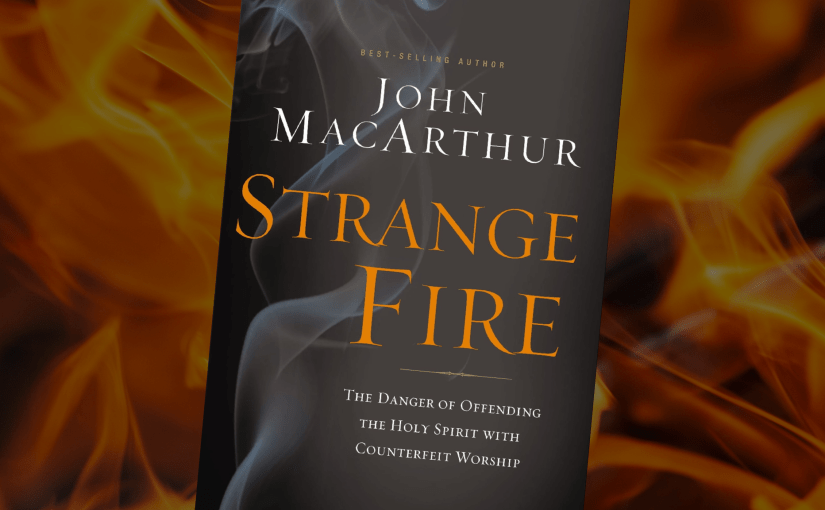
Book Review: Strange Fire by John MacArthur

John MacArthur believes that the entire Charismatic Movement is wrong. In his controversial book Strange Fire, he calls on faithful Christians all around the world to rise up, condemn the falsehoods that infiltrated mainstream evangelicalism, and go on a collective war against the pervasive abuses on the Spirit of God perpetrated by Charismatics. With colorful language that borders on sensationalism and an abundance of absolute claims that lack nuance, MacArthur asserts that more than half a billion Christians all over the world espouse heretical doctrines (xiv-xvi).

Continue reading Book Review: Strange Fire by John MacArthur

Book Review: Whose Religion Is Christianity?

Whose religion is Christianity? That’s the question we seek to find out in this 2003 book written by Lamin Sanneh, a Gambian professor of missions and world Christianity at Yale Divinity School. This book review will have three sections: a summary of the important points in the book, an evaluation of the arguments presented in the book, and a reflection as to how this book relates to the ministry context that I do at Every Nation Philippines. 

Continue reading Book Review: Whose Religion Is Christianity?